A new pond on Horfield Common
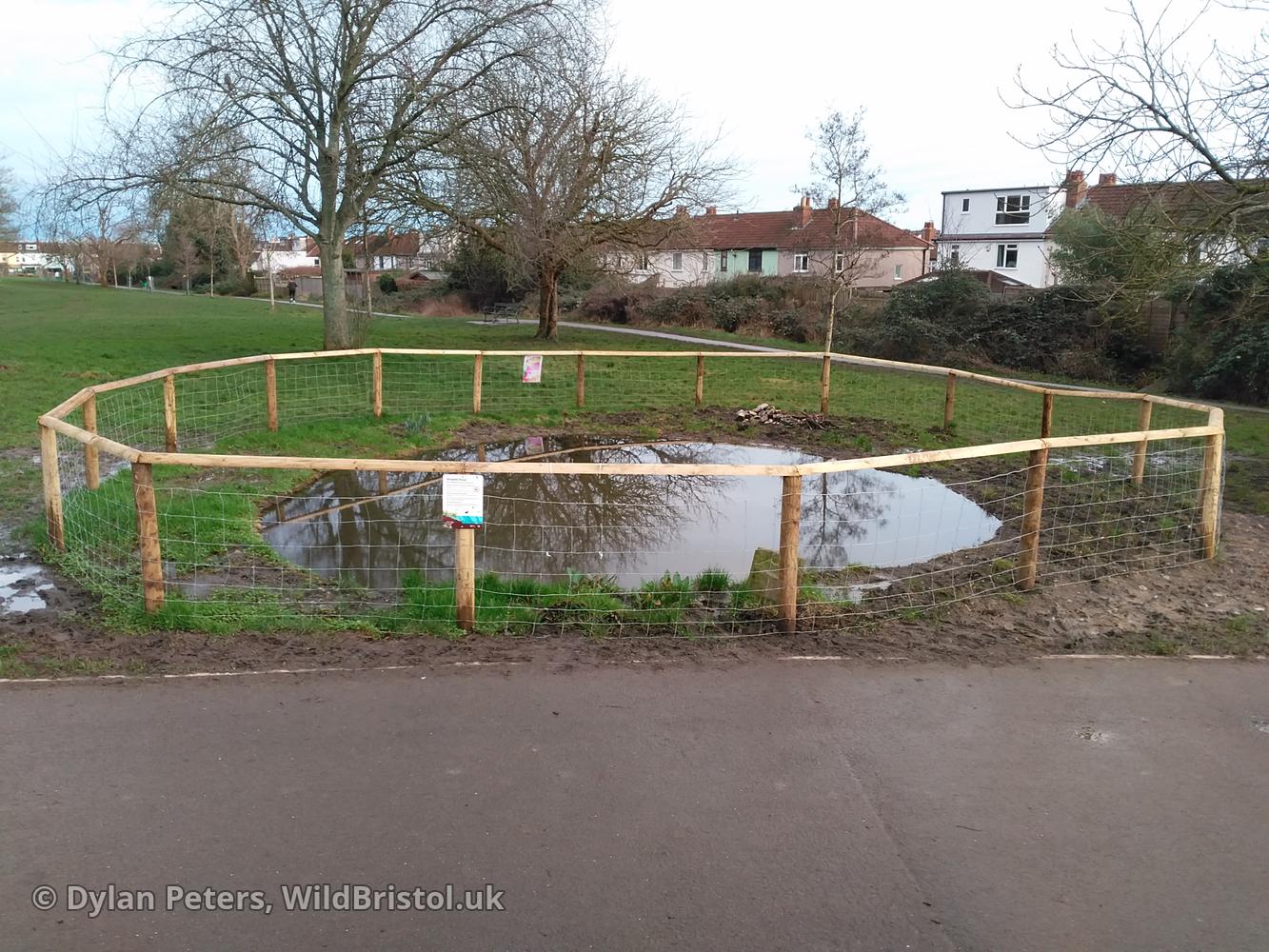
Introducing New Quab Pond - a new pond which has finally become a reality after a period of two years since I initially proposed it to the council and Friends of Horfield Common. Situated in the south-western corner [at ST58887630], it has been named after the farm house which once stood opposite (where the garages are now) and an extinct pond which formerly existed to the east [see Know Your Place https://maps.bristol.gov.uk/kyp/?edition=]. Historically Horfield Common had a number of ponds to provide water for grazing livestock. 'Quab' refers to boggy or muddy and is certainly apt for what is one of the boggiest parts of the Common and where until recently, an almost permanent muddy puddle once stood; having now been turned into an even bigger and muddier puddle!
Work commenced on the 2nd December with a mini digger and the following day, volunteers (including myself) spread the spoil around and fenced it off. Thanks to the naturally waterlogged soil and the presence of an intermittent spring, there was no need for it to be lined but merely an act of digging a hole and letting nature do the rest. It was filling up as it was being dug and was full within just three hours (quickest pond ever!). I later made several 'tweaks', expanded it slightly, reshaped it (as it was too perfectly circular) and levelled it.
Because this is a natural pond, the idea is to see what naturally colonises. Several water-loving / tolerant plants already existed here: Plicate Sweet-grass (Glyceria notata), Redshank (Persicaria maculosa) and Creeping Buttercup (Ranunculus repens); and with the close proximity to the original pond, it's possible that some locally extinct species may return. The seeds of some species can remain viable in the soil for an incredibly long time. Among the most exciting possibilities is Whorl-grass (Catabrosa aquatica) - an extremely rare aquatic plant in Bristol; only recently seen along the River Avon near St Anne's in 2009. Historically it was more widespread and is mentioned from "Pools on Horfield Common; Herb. Stephens." (White, 1912). Another is Horned Pondweed (Zannichellia palustris) recorded from "Horfield" by G.H.K. Thwaites (Swete, 1854). Floating Sweet-grass (Glyceria fluitans) is also mentioned from "Pools about Horfield" (Swete, 1854) but Plicate Sweet-grass (G. notata) is very similar and wasn't distinguished from it back then. Both species often grow together and so it is possible that this could have occurred. This is also mentioned in Stephens Catalogue (1835 [as Poa fluitans]). Other possibilities can be suggested from plants present elsewhere in the vicinity. Pendulous Sedge (Carex pendula) grows in the nearby ditch and so does Water-cress (Nasturtium officinale) which also occurs in a pre-existing pond (really just an extension of the ditch) along with Brooklime (Veronica beccabunga) and Reed Sweet-grass (Glyceria maxima). In another spot close by, next to a near permanent stream of run-off (and where another pond used to be), is a patch of Yellow Iris (Iris pseudacorus) appearing to be a relict. The wind dispersed seeds of Great Willowherb (Epilobium hirsutum) and Creeping Thistle (Cirsium arvense) for example should find their way around the margins.
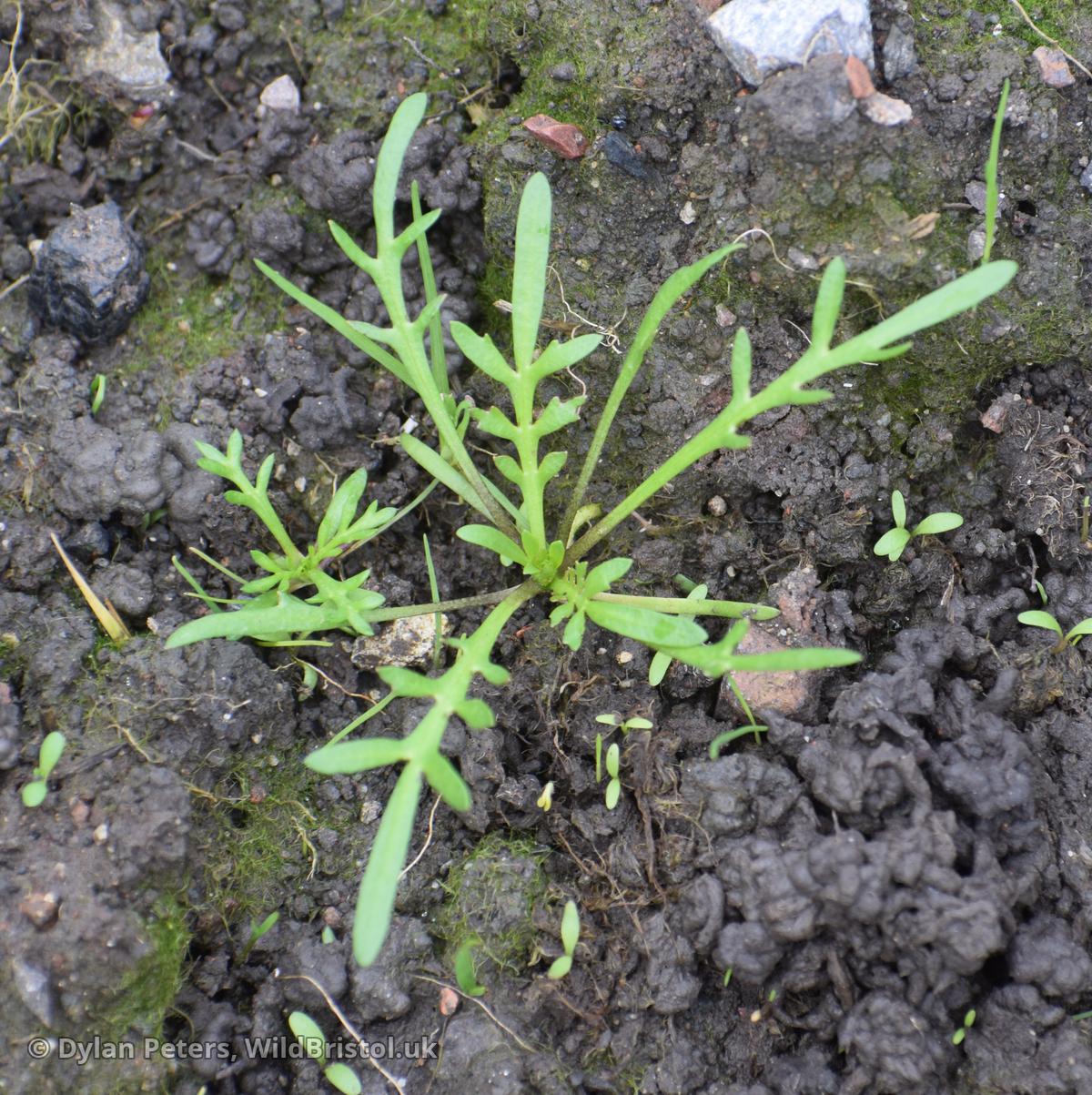
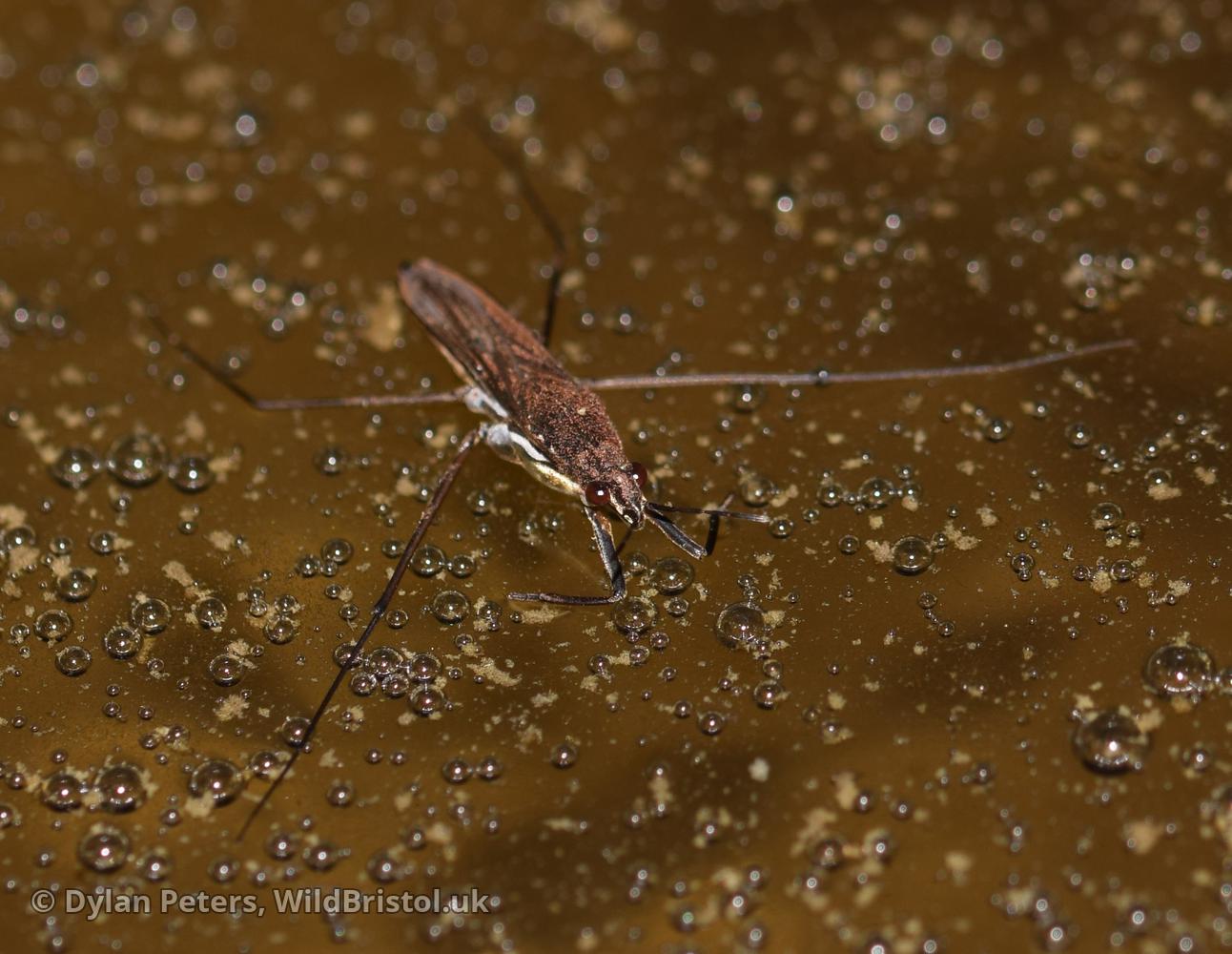
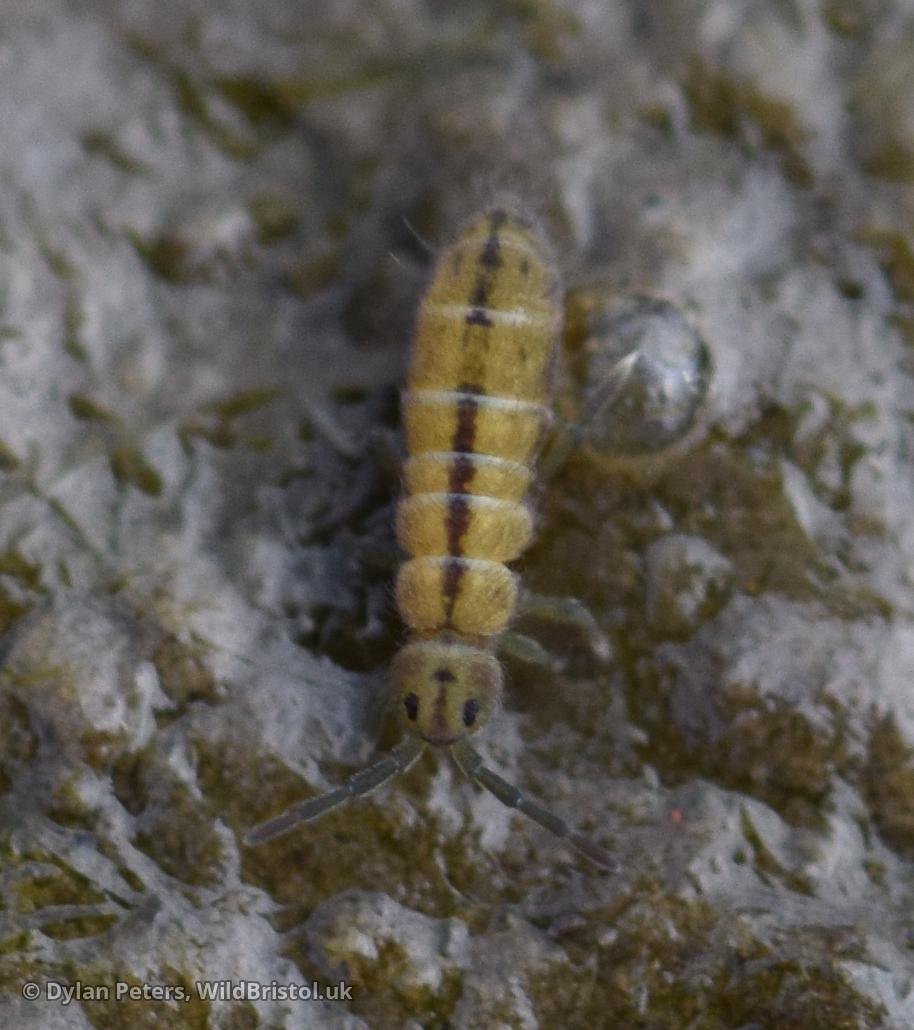
Now just over three months old (at the time of writing) and it's really starting to come to life. The disturbed bare soil around the pond has a myriad of seedlings emerging, the most notable so far being Swine-cress (Lepidium coronopus) which seems to be pretty scarce around Bristol (I've only seen it on two occasions locally) though its apparent abundant distribution baffles me. Either it's greatly declined, I've been incredibly unlucky, or more likely it's been woefully over-recorded for the far more common Lesser Swine-cress (L. didymum) - probably a combination of all three. The first organism to colonise the water itself was some sort of brown crusty cyanobacteria (possibly a Lyngbya sp.), quickly followed by several species of filamentous green algae yet to be determined. Invertebrate-wise the first Pond Skaters (Gerris lacustris) and Water Boatmen (probably Corixa punctata but I haven't been able to catch one yet) have already arrived along with a Non-biting Midge (Chironomus sp.), Parydra coarctata (a species of Shore Fly), Marsh Springtail (Isotomurus palustris), and countless others have become trapped on the water's surface. Curiously a single Two-spotted Water Hog-louse (Asellus aquaticus) and a Marsh Snail (Stagnicola sp.) were seen crawling along the receded margin (which I strongly suspect were introduced with pond plants that some ignorant person chucked in but both are present in the other pond 200m away). A single gastrid (pregnant) female frog was also found, unfortunately she had clear signs of Ranavirus and was later found dead (there have been several cases of this deadly disease locally in recent years).
It hasn't all been plain sailing though. On five occasions someone has been chucking in pond plants (which I've been taking out immediately) despite a clear and obvious sign saying not to, on countless occasions sticks and stones have been thrown in, pieces of bread to feed the invisible ducks, paper boats, bizarrely red Camellia flowers on two occasions, and most recently a scooter! (fortunately not an electric one).
Another problem has been that the water level drops quickly after a period of dry weather (not that we've had many of those recently) but it holds in the centre where the proper clay has been reached. The site is on a slight slope and annoyingly the depth was measured from the highest point which meant the clay layer only got scuffed and frustratingly the top soil got piled on the lower end and the clay on the top end so the water appears to drain through until reaching the natural water table. The solution is to dig it deeper and to spread the clay up onto the banks. It will always fluctuate but it would be nice if it could contain some water year round.
It is hoped that this new pond will provide much needed relief to the local amphibian population and all wildlife which calls Horfield Common home as well as giving passers by a reason to stop and glimpse a view from the past!
It will not be planted. There are several reasons for this. People seem to have an obsession with planting. In an ornamental setting such as a garden then fine but in the world of conservation (an objective which has unfortunately gone out of the window in recent years) it should be about allowing natural processes to take place and preserving what's already there (whether it's visible or not) through various forms of management.
it has the potential to introduce pests, diseases and invasive species.
and above all it's boring! The whole point of allowing natural colonisation is that it's fascinating seeing how it changes over time. It's the next best thing to having a time machine.
Thanks to historical texts, I know what once grew here. Relics of the past still remain and a picture can be built of what the past once looked like.
There were already a couple of plants often associated with waterways including Plicate Sweet-grass (Glyceria notata) and Redshank (Persicaria maculosa) other plants present included Creeping Buttercup (Ranunculus reptans), Silverweed (Potetilla anserina), Broad-leaved Dock (Rumex obtusifolia), White Clover (Trifolium repens), Knotgrass (Polygonum aviculare), Greater Plantain (Plantago major), Pineappleweed (Matricaria discoidea), Perennial Rye (Lolium perenne), Annual Meadow-grass (Poa annua), Rough Meadow-grass (Poa trivialis), Cock's-foot (Dactylis glomerata), Timothy (Phleum pratensis), False Oat-grass (Arrhenatherum elatius), Creeping Bent (Agrostis stolonifera) and Wall Barley (Hordeum secalinum). Plicate Sweet-grass (Glyceria notata) Plicate Sweet-grass (Glyceria notata) - a relic of the past; occurs in the pond at the bottom of the Common. Redshank (Persicaria maculosa) Redshank (Persicaria maculosa) popped up for the first time after a near permanent muddy puddle (opposite the garages - what was Quab Farm) - caused by a spring, dried up. They are no doubt descendants of the past ponds which once occurred in that area; 1st October 2023.
Clay soils are fantastic for preserving objects and seeds can remain dormant for an incredibly long time only germinating once the right conditions come to light.
The first plant expected to colonise the water itself is a type of filamentous green algae called Cladophora glomerata
The plan is to see what naturally colonises and let it do its thing. After an extended period the introduction of plants from the existing pond and other places from around the Common. These include:
For the pond itself:
Yellow Iris (Iris pseudacorus) - relict patch growing by the garages
Brooklime (Veronica beccabunga) - from existing pond
Water-cress (Nasturtium officinale) - from existing pond
Amphibious Bistort (Persicaria amphibia) - from soil bund at Wellington Hill entrance of Wellington Playing Field
Reed Sweet-grass (Glyceria maxima) - from existing pond
For the banks and margins:
Meadowsweet (Filipendula ulmaria) - from Horfield Parish churchard
Creeping Jenny (Lysimachia nummularia) - from Horfield Parish churchard
Toad Rush
Pendulous Sedge (Carex pendula) - from nearby ditch
Hairy Sedge (Carex hirta) - from Cat-mint area
Remote Sedge (Carex remota) - from behind Horfield Parish churchyard
Meadow Vetchling (Lathyrus pratensis) - from Horfield Parish Churchard or Donkey Ln
Tufted Vetch (Vicia cracca) - from Horfield Parish Churchard
Lesser Celandine (Ficaria verna) - from nearby ditch
Common Fleabane (Pulicaria dysenterica) - from meadow behind Horfield Parish churchyard
Creeping Thistle (Cirsium arvense) - should naturally colonise otherwise from nearby ditch
Cuckooflower (Cardamine pratensis) - from one of a number of areas
Winter-cress (Barbarea vulgaris) - from one of a number of areas
Water Figwort (Scrophularia auriculata) - from lane between Radnor Rd and Longmead Ave
Great Willowherb (Epilobium hirsutum) - should naturally colonise otherwise from nearby ditch
Hoary Ragwort (Jacobaea erucifolia) - from Horfield Parish Churchard
Meadow Buttercup (Ranunculus acris) - from one of a number of areas
Red Clover (Trifolium pratense)
Wavy Bittercress (Cardamine hirsuta) should naturally colonise Meadow Fox-tail (Alopecurus pratensis)
With the new pond on Horfield Common now settled, some may be wondering why it hasn't been planted? With it being a natural (unlined) pond, it is to be left alone to see what naturally colonises - a very exciting process. The ground here has always been boggy and in the past there were several ponds in the vicinity. This means there is the potential for long dormant seeds from a past aquatic flora (some of which can survive for hundreds of years) to re-emerge from the disturbed mud. There were several water-loving plants already present on this boggy piece of ground prior to its construction and they are expected to return. Someone (probably with good intentions) has already chucked in a clump of aquatic plants (Fool's Water-cress and Brooklime) despite the clear sign. Please do not introduce anything. This is how invasive species and diseases are spread and it defeats the object of observing how the pond naturally evolves overtime. Thank you. For more information see https://wildbristol.uk/location/new-quab-pond/
This is a naturally boggy area with several springs in the vicinity. Historically a large pond occurred to the East of it and two more existed further to the West. It is named after the former farm house 'Quab Farm' which stood where the garages are today.
It will now be left to its own devices and regularly monitored to observe how it changes over time - an extremely exciting process. The disturbance will have reawakened long dormant seeds and it will be interesting to see what naturally colonises.
A pair of opportunistic Pied Wagtails were seen picking for surfaced worms during its creation.